
The Story of the Indian Memorial
By Bob Reece
Review complete coverage of the Indian Memorial Dedication on June 25, 2003
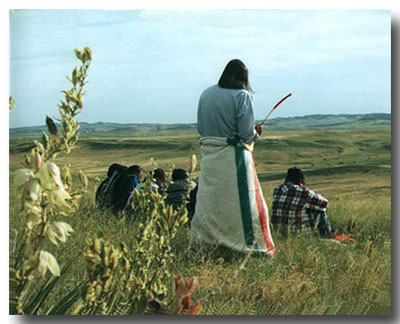
Donlin Many Bad Horses at future site of the
Memorial
Photo
© Rodney Bridgers
Seventy-Six years ago a
letter was sent to the U.S. Department of the Army from Mrs. Thomas Beaverheart.
She requested that markers be dedicated to the fallen warriors on the Little
Bighorn Battlefield so that, “the place might be remembered on the next
anniversary.” She never received a reply.
Over the decades, similar
requests followed but all fell silent. They were either ignored or false promises were given.
Frustrated by this seeming lack of concern, Russell
Means led a contingent from the American Indian Movement to the battlefield on
June 25, 1988. On Last Stand Hill, they dug into the soldier's mass grave and
placed a makeshift plaque which was their representation of a memorial to the
Indian warriors. At that moment, both Neil and I were acting as guides on two
buses loaded with folks following Custer’s trail up the Rosebud. We arrived at
the battlefield about an hour after the demonstration was finished and Russell
Means long gone. We looked upon the plaque and wondered if this day would drive
the necessary forces to finally make a change.
It did. Within three
years President George H. Bush signed into law the bill that would change the
name of the battlefield from the Custer Battlefield National Monument to the
Little Bighorn Battlefield National Monument. The bill stated, “The public
interest will best be served by establishing a memorial…to honor and recognize
the Indians who fought to preserve their land and culture.”
The estimated cost to build the Memorial
was $2.3M. Where would this money come
from? The 7th Cavalry Monument that stands on Last Stand Hill cost
$500 in 1881. That was a lot of money back then, too.
Attempts were made in good
faith to raise the funds for the Indian Memorial, but time dragged on with no
success.
In March of 1998, Neil Mangum came on board as the
battlefield superintendent. He and I sat on a committee with the National Park
Foundation whose purpose was to design a plan to raise the funds. Even though a
plan was soon in place, the money barely trickled in.
With determination and
resolve, Neil met with U.S. Senator Burns of Montana while in Washington D.C. on
business in February 2001. Neil basically reminded Senator Burns that 10 years
after President Bush signed the bill, there was still NO memorial. Something
needed to be done.
Following this meeting, Senator Burns ensured $2.3
million was included in the Department of Interior’s appropriation bill for
construction and maintenance of the Indian Memorial. The bill passed through
committee and approved on the floors of the House and Senate in September 2001.
Ironically, it would be President Bush’s son, George W. Bush, who would now sign
the bill that approved the funds to build the Memorial.
We all can give Mr. Mangum credit and thanks for his resolve in seeing this through after a
long 125 years.
View
photos of the construction of
the Memorial.
"The time has come to give equal honor to the Indian people
who've been denied that for so long" U.S. Senator Ben Nighthorse
Campbell (Northern Cheyenne)
"We want a place where the Native descendants can feel welcome
and believe one's people had done a courageous and good thing..." Arthur
Amiotte (Oglala Lakota), Memorial Advisory Committee
(Back
to Top)
|

 "...my
heart is glad that I can shake hands with these chiefs, some of whom I fought
against with Custer on that great battlefield...as I look into the faces of
these great chiefs who were once my enemies...I will never lift the coup stick
again, I will live as a brother to all the tribes, and at peace with all men..."
"...my
heart is glad that I can shake hands with these chiefs, some of whom I fought
against with Custer on that great battlefield...as I look into the faces of
these great chiefs who were once my enemies...I will never lift the coup stick
again, I will live as a brother to all the tribes, and at peace with all men..." |
|