| Friends Of The Little Bighorn Battlefield |
The Next Generation In The Study Of Custer's Last Stand |
Dig of 1984 |
| • The Battle • Archeology • Memorials • Little Bighorn Store • News • Book Reviews |
|
|
||||||||||||||||||||||||||||||

|
|
|||
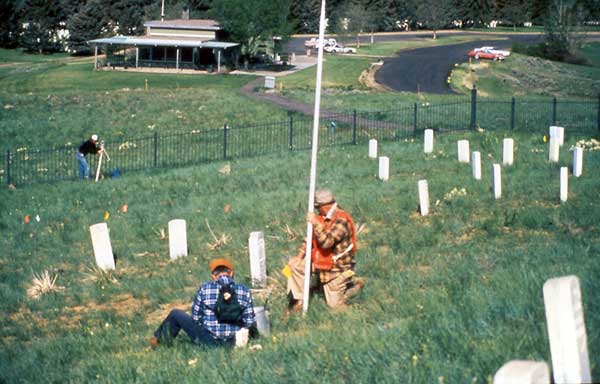
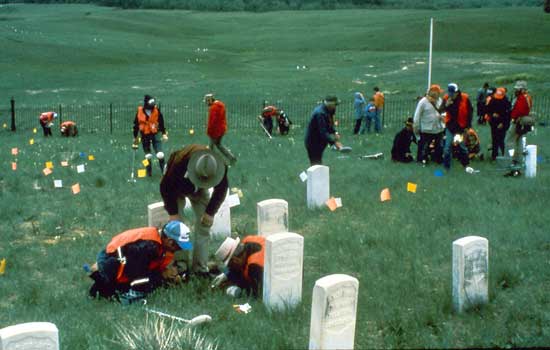
Random marble markers, denoting where a trooper fell, were excavated for human remains. Remains were found under each marker studied. These remains were analyzed by forensic pathologists for many reasons -- age, height, race, and means of death. Once all the analysis was complete, the remains were buried with full honors in the Custer Battlefield National Cemetery.
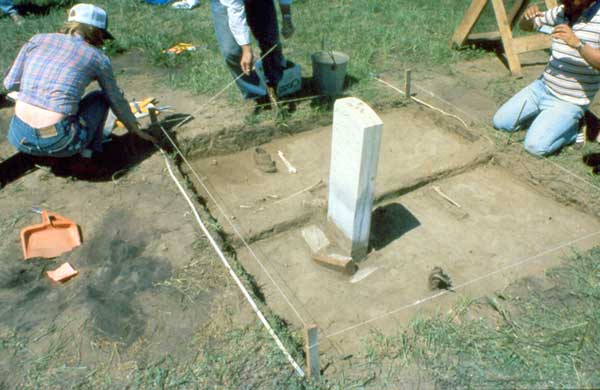
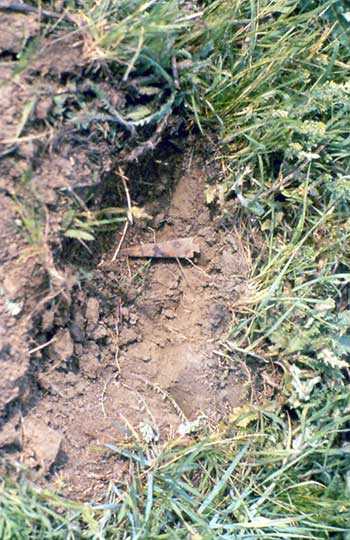
This marker is in the Keogh sector. The bottom of a cavalryman's boot can be seen as well as human bone.
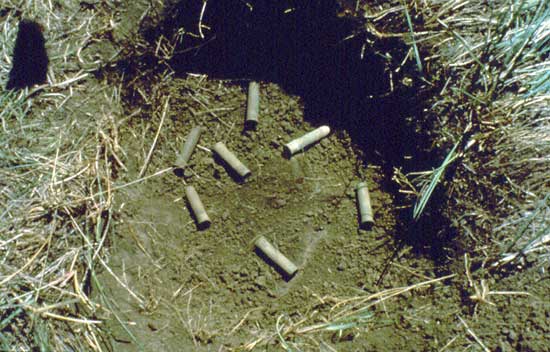
All types of artifacts were discovered -- spent cartridges, bullets, buttons, a few arrowheads, boots, and much more. Below are examples of items found.
|
|
|
|
|


The digs continued the following summer with the focus being the Reno-Benteen Defense site. A follow-up dig at Reno-Benteen was conducted in 1989. In 1994 another dig, although small compared to the pervious ones, was performed in areas north of the Custer Battlefield National Cemetery. In September 2004 a road survey was conducted. Read more about it.
We will keep you informed of any digs that may occur in the future.
Update July 2008: Jeff Martin of Colorado posted a question in our guestbook on July 5. He asked, "in 30 years every metal detector hobbyist will want to know what kind/type detectors were used. I think it would make sense to capture that info now before it is lost."
To answer Jeff's question, I contacted Friends member John Husk who participated in the digs during the 1980s. I figured he’d be able to enlighten us. Not only did he do just that, but he sent me a photo from the cover of the September 1985 issue of Treasure magazine which covered the May 1985 dig conducted at the Reno-Benteen Battlefield. The photo was reversed (who knows why) and the soldier headstone was added but it shows you an example of the detectors used 23 years ago.
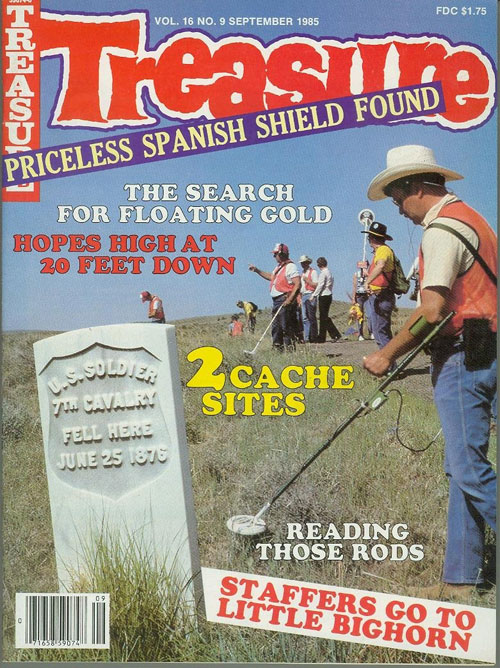
John Husk on the cover of Treasure Magazine -- enlarge for details
Here is what John says regarding what kind of metal detectors were used
during the digs in the 1980s:
“I can't tell you the model of the metal detectors but can say that the
Garrett, White and Fisher were the principal brands on the field.
Occasionally someone would show up with another brand. The Fisher rep was
one of the people doing the detecting so his were the most up to date. I
was using a Garrett ADS, VLF/TR Deepseeker with two different sized heads depending on the
conditions and the weight of the head at the end of the day and Ron
Nichols was using a White. The battlefield bought either a White or Fisher
during or right after the dig in 85. At that time, they were the top of
the line metal detectors for the early to mid 80's. Nothing like the
computerized metal detectors that are out there now.
In the photo, I am in the front, Ron is in the yellow shirt and the Fisher
rep is in the red and white baseball cap wearing a t-shirt with an orange
vest over it. This photo is reversed but was on Reno-Benteen. I have a
hand-held Garrette on my belt. The granddaddy of the wands they use in
airports now. Also I had a 'handle with arm rest' that I am using in the
photo which allowed me to take the head and shaft off the metal detector
instrument box. That way I could hang the box over my shoulder and just
use the handle, shaft and head for reduced weight.”
Archeology Home
Copyright 1999-2013 Bob Reece
Revised:
Monday June 01, 2015
Friends Little Bighorn Battlefield, P.O. Box 636, Crow Agency, MT 59022
| Home |
Board of Directors |
Guest Book | Contact | Site Map
| |
|