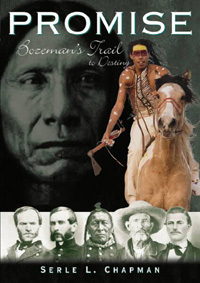
Promise: Bozeman's Trail to Destiny
by Serle L. Chapman
Book Review by Bob Reece For The 140th Anniversary Of The Fetterman
Battle, December 21, 1866.
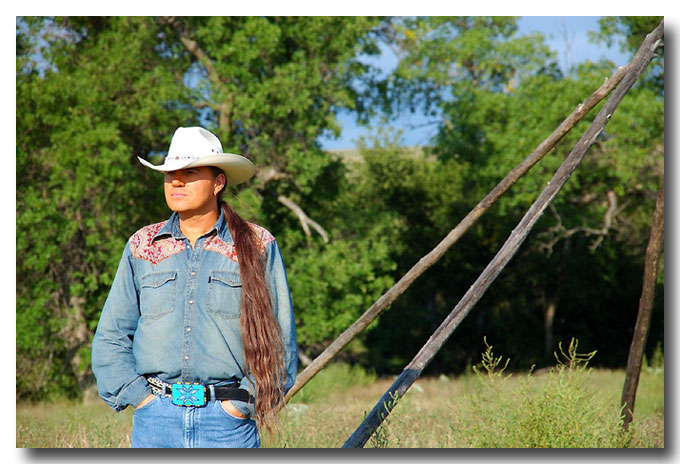
Serle L. Chapman at Dog Soldier's Village on the Pawnee Fork
Photo courtesy Simon Morgan
The handful of
soldiers, along with their white men scouts Billy Dixon and Amos Chapman, traveled across the
Llano Estacado
wearily, but
alert watching out for Kiowa, Comanche, or whatever else might expose them
to immediate danger. It had been a long journey and getting home must have
been a priority; however, that homecoming would be cut short in dramatic
fashion.
One can see far and
wide while standing on the plains inside the panhandle of Texas. In the
days before man built infrastructures and planted trees, one could see
forever. Seeing forever must have driven one crazy during a full day’s
ride on a horse. When Chapman and the others first saw the dots on the
horizon, they wondered what they were. They’d find out soon enough.
They probably heard
the whiz and ping of bullets flying through the air and striking the
ground before they figured out what the dots were. So, where does one go
for shelter from bullets when on the Llano Estacado? There were no trees,
no rocks, no buildings, nothing. One prays that his horse is a bit fresher
than the horse carrying the fella shooting at you. If that fails, then one
must stand and fight, but what if you’re outnumbered 20 to one?
Chapman knew what to
look for in shelter. Running the horses hard, it still took time to find
that shelter. In the distance he spotted buffalo wallows; those shallow
earthly depressions where buffalo would roll on their backs into the
ground. He moved the soldiers toward those craters as the enemy quickly
gained on them. Private Smith went down, the others continued jumping into
the wallow. Ping, whiz, ping, ping.
Chapman finally
recognized the enemy: Kiowa, and around 100 of them. Hell, he even knew
some of them. He heard the groans coming from the mortally wounded Smith
far away, out on the Llano. The horses with their canteens were lost, now
in the hands of the Kiowa. Without time to catch his breath, Chapman ran
for Smith and his extra ammunition 100 yards away. Whiz, whiz, ping, ping.
Chapman grabbed
Smith and retreated toward the buffalo wallow with a dozen Kiowa in hot
pursuit. A bullet struck Chapman in the leg, but he kept moving with his
heavy load. As Chapman and Smith tumbled into the wallow, there came a
loud crack which must have been recognizable to every soldier cradling
hard to the ground. The excruciating pain was undeniable to Chapman. His
leg had snapped in two. At least they had the extra ammunition. Smith
succumbed to his wounds, and started his final march as he let out his
last breath. He was in a better place, and for now the rest of
them had a chance. Chapman would worry about his leg and getting home
later. For now, he fired his carbine.
And then, something
strange happened; the Kiowa simply rode away. The Battle of the Buffalo
Wallow was finished. Chapman and the soldiers felt very lucky. Just
moments before, they were doomed; now they would make it home hurt but
alive.
Chapman was awarded
the Medal of Honor for his actions in recovering Smith
during the Battle of the Buffalo Wallow. Chapman eventually married Mary
Long Neck of the Cheyenne tribe. They had children, and one of their sons
became the father of Serle L. Chapman whose book is reviewed here.
The Promise
overture finds Mr. Chapman standing before the monument that remembers his
grandfather and the soldiers’ battle in the buffalo wallow on the Llano
Estacado. It is here that our journey begins; the narrative style moves
gracefully from lyrical to legend to history and back again. It takes a
little getting used to, but once understood, the book feels like a journey
on a blanket of clouds during time travel. It’s a truly unique and
wonderful experience for a historical storyline.
The spirit and
sensitive soul of Mr. Chapman comes through loud and clear in every page
of Promise. Amos and Mary Long Neck Chapman shine brightly within
their grandson. His words are resolute yet poetic, his understanding of
the Cheyenne way and white man’s world combined produce a work of deeper
understanding from which the reader can learn and gain enjoyment.
Promise
comes in an oversized package perfect for its display of beautiful
photographs (also by Chapman) of Wyoming; its wildlife, its history, and
its people both past and present can be fully appreciated throughout the
pages of the book. Descendants of important people from the Cheyenne and
Lakota share their accounts of life along the Bozeman Trail. Leaders from
the Ft. Phil Kearny Association share their knowledge of life in the forts
along the trails as well. Wonderful portrait photographs of each of these
contributors garnish the pages of this book. Mr. Chapman is an
award-winning photographer, and his talent is evident throughout.
We quickly learn
that the classic clash of cultures was very complex. Mr. Chapman first
takes us on a fantastic journey of the frontier life through a fictional
character, a white woman traveling over the Bozeman Trail. We read from
her daily journal and learn of the hardships and dangers these people
faced every single day. These travelers of the trail were full of optimism
in the challenges that came from making a new life: their new life full of
promise and hope.
Promise
soars highest when Mr. Chapman tells the story of Red Cloud’s War with
emphasis on the Fetterman Battle. This time his character is an unnamed
old Cheyenne warrior reflecting back on his younger years: the days of
Sand Creek, the attack on Julesberg, Battle of Platte Bridge, Battle of
Beecher Island, and more. It is truly fascinating to experience this
history in terms of Cheyenne thought, language, and perspective.
An incident during
the Red Cloud War involved a brief moment when Lakota warriors beat
Cheyenne leaders with their bows, while claiming the Cheyenne were
cowards; they counted coup on an ally. Mr. Chapman spends valuable time
with this incident and for the first time reveals its total effect on the
Cheyenne people.
Mr. Chapman’s story
of the Fetterman Battle is the version told from the Cheyenne and Lakota
perspective, published here for the first time. Mr. Chapman doesn’t just
rely on oral history; he also corroborates these accounts with the
historical record. The book includes extensive endnotes. Thus, Mr. Chapman provides us with the most detailed account of the Fetterman Battle to date.
Mr. Chapman’s old
warrior narrator tells a painful story of death and grief with graceful
language. Death doesn’t come easy in Promise, and it doesn’t come
without purpose. As the Fetterman Battle opens, warriors wait in gullies
and ravines for Crazy Horse and the other decoys to return with soldiers
to kill. It’s cold; there is fear in the narrator’s voice:
There were no
soldiers, or none that we could see, until Crazy Horse brought them…the
soldiers came up in a cloud behind this man and fanned along the edge of
the Lodgepole Hills as feathers in a bustle. Bullets fell around him,
the hail from that blue cloud, but he was not hit, although I thought
the pony must have been shot in the leg when the man began looking at it
that way. Yes, this was Little Hawk’s swift pony, and so the man had to
be Crazy Horse. As far away as we were, you could see his long hair like
the color of that pony, hanging loose and falling over a red blanket
which he had tied over his war shirt and blue leggings. It did not seem
that the soldiers wanted to follow Crazy Horse, and they stood looking
down at him, walking soldiers in the middle of some pony soldiers. (page
102)
Death doesn’t come
easy along Massacre Ridge as the narrator explains:
Those still on
horses were whipping them, and it was odd to see these men (soldiers)
moving so fast and their horses moving so slow. One of them fell off and
seemed to pull his horse on top of him. I saw three arrows in this
horse…Some Little Stars counted coup on the soldier but were pushed away
from him by much shooting. Then the shooting stopped, and the soldier’s
arms started to claw at the ground but his legs would not work. Maybe the
horse had broken his back, I do not know. Wherever he is now, he is
crawling still, for the women of the Little Stars finished him. The pony
soldier on the white horse was still among the Little Stars, and I was
much closer now, so close that I could hear the iron hooves of the
soldiers’ horses on the hard ground and the noise the pony soldier chief’s
long knife made when he cut the head off a young boy who tried to shoot
him but snapped his bowstring. (page 105)
The narrator shares
his feelings of battle as Captains Fetterman and Brown come closer to
death:
Some of the pony
soldiers were not shooting, they were trying to hold onto their big
horses. The smell of blood and smoke was all around, and even now when I
see a herd of elk I can see these soldiers. Just as elk cows with their
thin-legged calves will crowd together and turn one way and then another
and then back again in fear, so did these soldiers. It seemed as if the
two soldier chiefs were shouting at each other, but I do not know if
they were, as everything was lost in the screams of dying horses and
men, the snap of guns, our strong heart cries and the thunder of our
ponies’ hooves hunting the soldiers who broke away. We moved as
swallows, cutting through the air with our arrows, our ponies on the
wing taking us above the fighting where it all became quiet. But it was
not, that is just a place you go to sometimes in a fight. (page 107)
There is no doubt in
my mind; Mr. Chapman’s accounting of the Fetterman Battle is the best I’ve
read for its accuracy and dramatic effect. His battle is not just about
soldiers positioned here and Indians attacking from there; instead it tugs
at our hearts. Soldiers and Cheyenne men and women warriors were willing
to die, for some in a strange place so far from home, in order to make a
better life. Finally, there is a version of the Fetterman Battle that is
heart filled.
__________________________________________________________________
Webmaster's Note:
Promise was awarded the Wyoming State Historical Society prize for
history writing in 2006.
Mr. Chapman, along
with his wife Sarah, runs
Go Native America, which provides an incredible
assortment of tours to historical places in the American West. I had the
opportunity to spend a day with Mr. Chapman in early November 2006. He
graciously led me across eastern Wyoming, and north of the Black Hills to
places of historical significance for the Cheyenne and Lakota. Mr. Chapman
is a great storyteller; he is a modern-day oral historian, and anyone
lucky enough to take a tour of the west with him via Go Native America is
fortunate.
Further
Reading On This Subject
Another Version Of The Fetterman Battle By
Friends' Member William Price
A Photographic Tour Of The Fetterman
Battlefield
John Doerner's
report on the discovery of a Fetterman soldier's remains
Bill
Markland's Website -- many of the official reports from Col. Carrington,
Ten Eyck, and Surgeon Horton.
Billings Gazette Article On The Descendent
Of Col. Carrington
(Back
to Top)
|