By John Doerner, Chief Historian, Little Bighorn
Battlefield National Monument
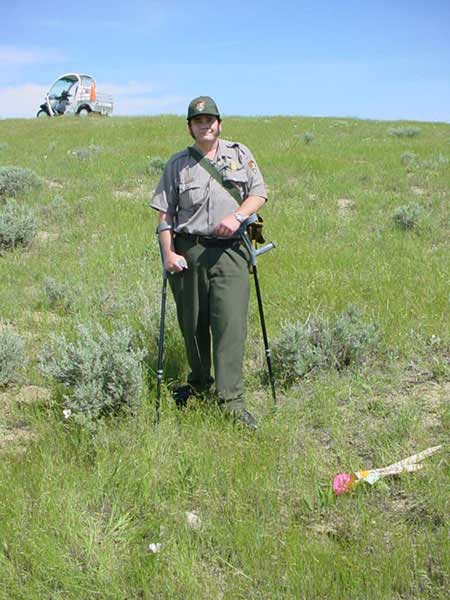
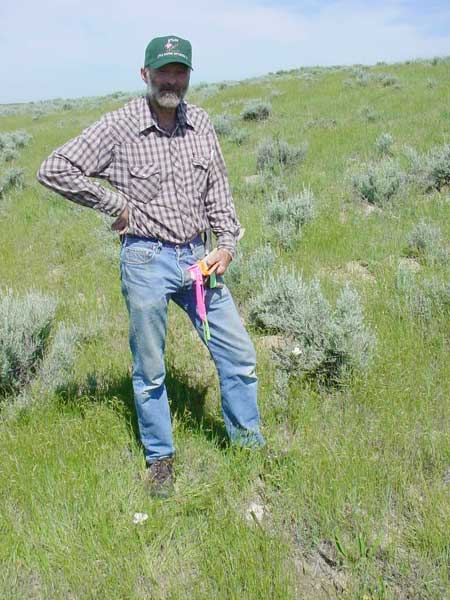
Photos courtesy Little Bighorn
Battlefield National Monument, John Doerner and Sharon Small
Webmaster's Note: Past Friends board member,
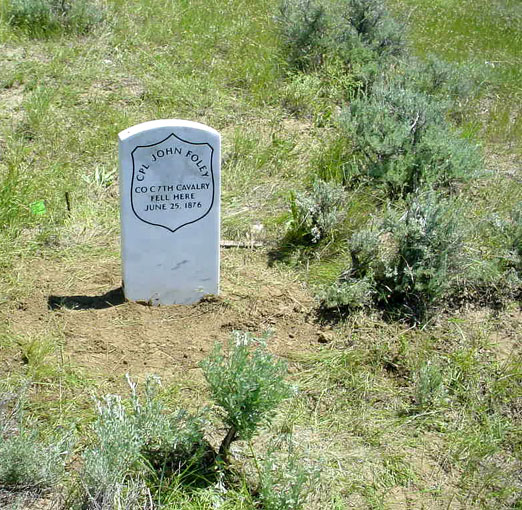
Chip Watts, had a long-time dream to memorialize the soldier John Foley with a
white marble marker somewhere in the Medicine Tail Coulee area. Note on very
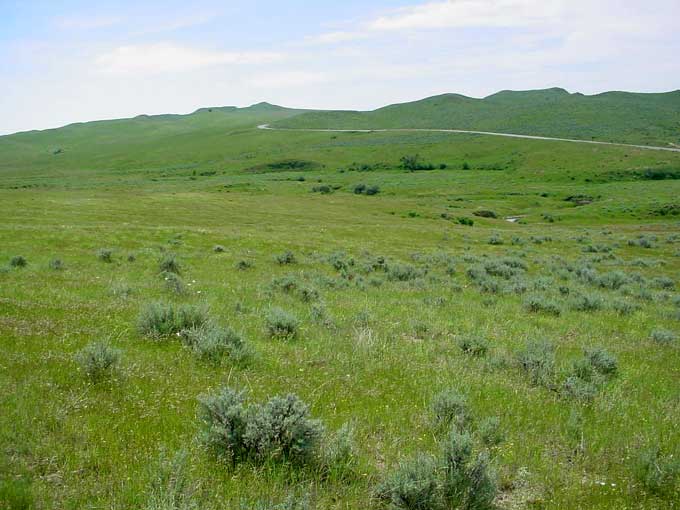
rare site in photos -- water flowing in Medicine Tail Coulee.
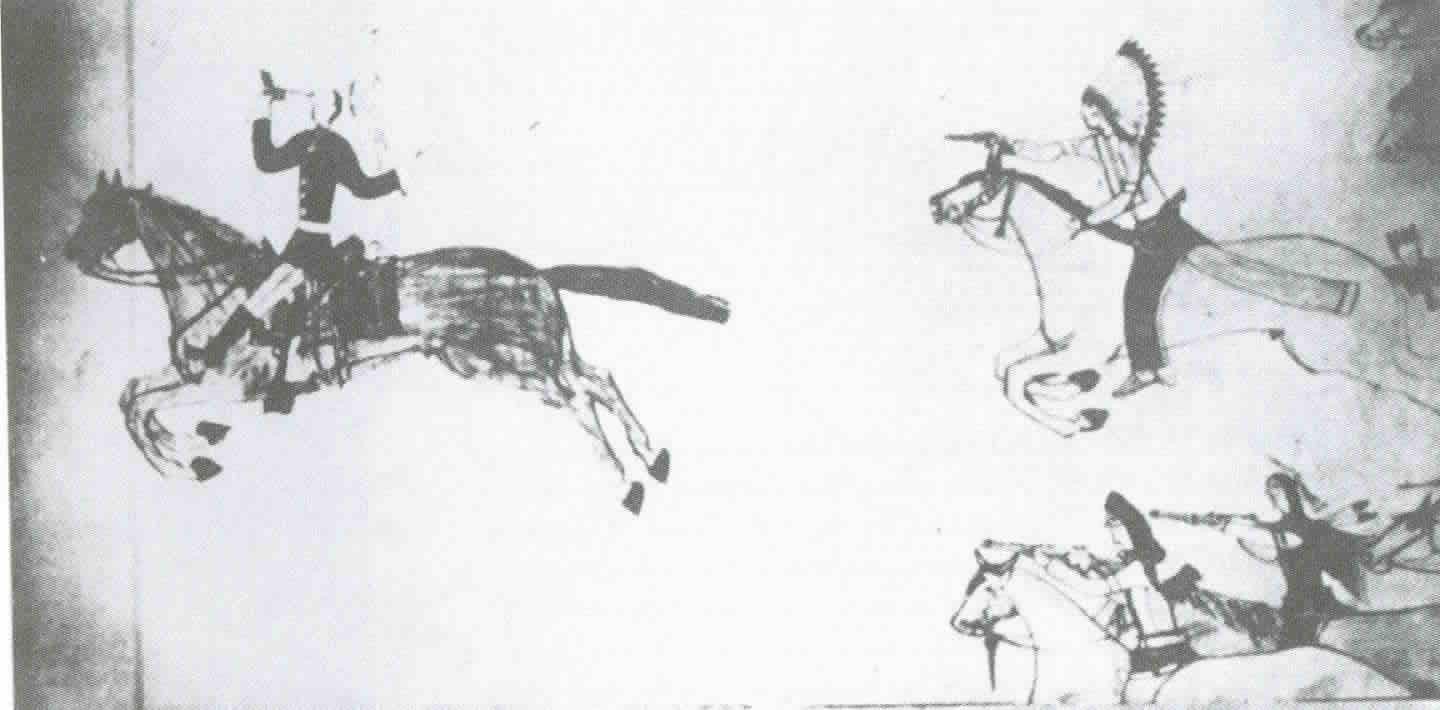
Bad Heart Bull ledger drawing showing Foley
shooting
himself with his Colt's revolver
Chip Watts went out with
me Tuesday June 5th and helped us locate the cairn as the grass was
high and you could stand on top of it and miss it! I showed it to him years ago
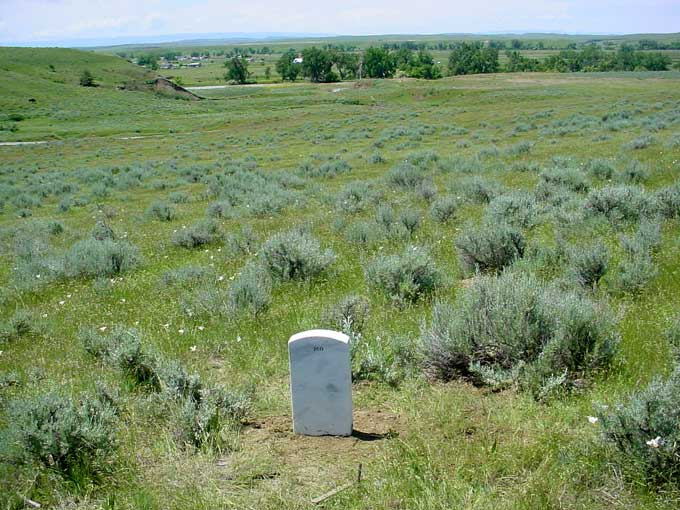
and had not seen it again until now. Foley's marker will really add to the
cultural landscape and is easily visible from the Medicine Tail Coulee bridge.
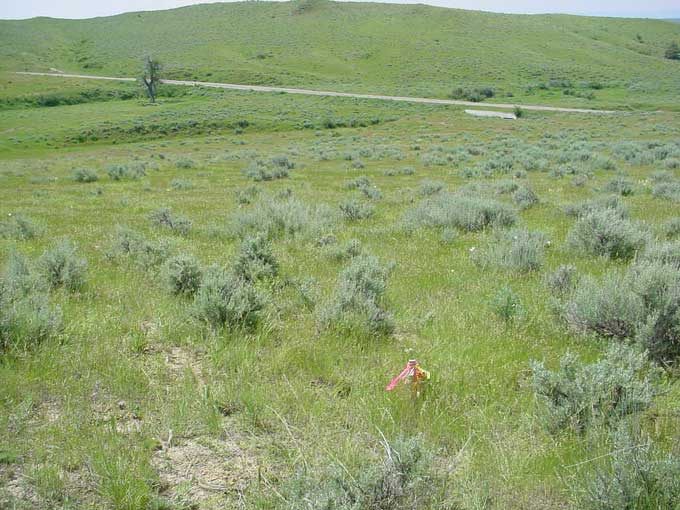
Below are a few shots of the wooden stake to better locate the site (note the
Cottonwood in Medicine Tail; another rare site - Medicine Tail Creek full of
water and the tour road bridge).
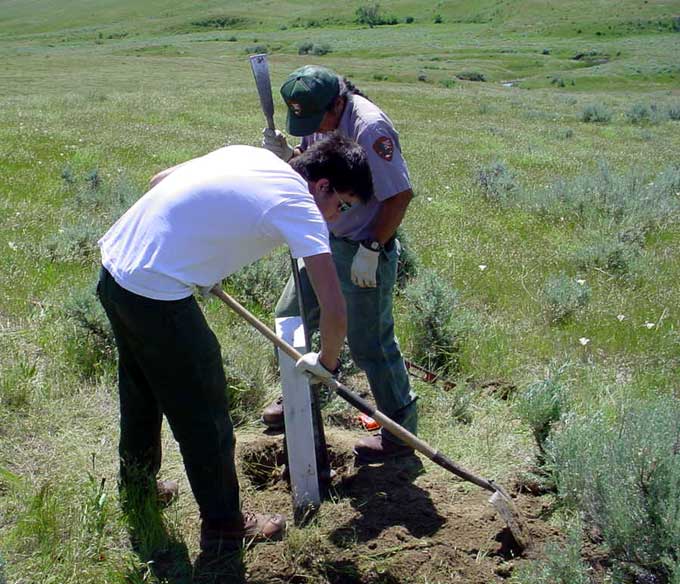
We placed
Foley's marker on the
field June 11, 2007. It is located just south of Butler's marker along the west
slope of Medicine Tail Coulee.
The following are some of the historic accounts
about Foley's courageous breakout from Custer Hill and pursuit by several
Lakota's. My favorite is:
"I saw one soldier ride across a hollow and try to get away. I was the third
Indian to give chase. The soldier rode like the wind and appeared to be getting
away from us, when he killed himself." - Turtle Rib, Minnikojou Lakota
"One soldier on a sorrel horse tried to get around the Indians. He was on a
sorrel horse with white legs. The Indians took after him, and shot at him, but
could not catch him. They saw some smoke and the report of a gun, and saw him
fall off his horse. The Indians went over and he had shot himself. Someone of
the Hunkpapa band got the horse and tied him to a stake. Everyone went to look
at it." - Red Feather, Oglala Lakota
"Within an hour they [Custer's Battalion] was completely surrounded, and as they
were without time to entrench or otherwise fortify their positions, they were
soon all lying dead upon the field where the granite monument now stands. Not
exactly all, for a few who retained their horses broke away down the ridge to
the southeast, with the intention, presumably, of forcing their way back to
Reno. Before they had gone on-half mile, not a man was left alive. These
latter bodies having been found between Custer's position and Reno's, it had
been supposed they were the first killed. Instead, it was shown that they were
the last to fall." - Gall, Hunkpapa Lakota
"Riding with a squad of soldiers [June 1877], War Club, Oglala U.S. Indian Scout
told how five soldiers - 'good fighters' - had broken from the hill where Custer
fell, and had fled in the direction of Reno's command; how
they had killed two here, a little further on two more, and how the fifth,
mounted on a swift-footed, strong bay horse had outdistanced his pursuers, until
they concluded to let him escape 'to tell the tale,' and how, after
they had turned back, hearing a shot they looked to see the lone rider withdraw
a pistol from his own head, and reel from the saddle, dead - the terrible sights
through which he had passed had turned even this soldier's
brain." - Unidentified Correspondent, Chicago Tribune, August 13, 1877
"I saw no man get away, but have heard four different eyewitnesses tell of one
soldier who rode through the Indians on a very swift horse which they could not
catch. They told that after chasing him for about a mile or two the soldier
drew his pistol and killed himself. This we could not understand because
the man's horse was swifter than ours and was continually getting farther away
from the pursuers." - Foolish Elk, Oglala Lakota
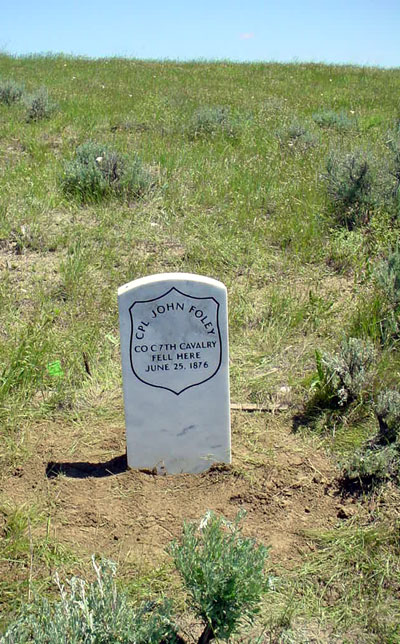
Foley's white marble
marker was supplied by the Veterans Administration and is the same Civil War
style that was first placed on the battlefield in 1890 by the U.S. Army to
denote and preserve 7th Cavalry casualty sites. Foley's marker
includes the following information:
CPL JOHN FOLEY
CO. C 7TH
CAVALRY
FELL HERE
JUNE 25, 1876
(Back
to Top)
|