Commentary by Bob Reece
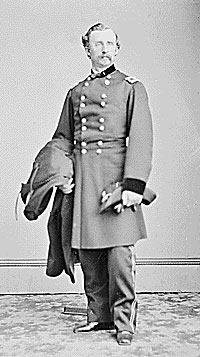
“Custer was a psychopath which always gives you
a leg-up; makes you more active and more imaginative in your strategies…
So, Custer goes to the Senate, he says, ‘there is gold, there is gold in
them thar hills.’”
David Milch, Executive Producer,
Creator/Writer Of HBO's “Deadwood”
Photo courtesy National Archives
The HBO series, “Deadwood”, was released on DVD
today, February 8, 2005. I love that show.
I looked
forward to each Sunday evening and the next show in the series to see what
happened next to Seth Bullock or Calamity Jane or to find out how much
longer Wild Bill had to live.
From the get go, from the opening scene of the first
show, which was directed by the all-time great western film director
Walter Hill, I was hooked. The writing is crisp, original, Shakespearean,
and better than most theatrical films.
I’m coming from a place where I don’t watch
television shows, sitcoms, or whatever you want to call them. What little time I give to TV is spent watching
documentaries on Discovery, History Channel, and such. So, a drama has to
be good to get me to watch it.
Needless to say, I was looking forward to “Deadwood”
finally available on DVD. It is a great DVD; all the episodes from
the first season are available. However, I was shocked when I saw and
heard Mr. Milch make the above comment about Custer in one of the extra features
on the DVD.
Shocked for many reasons. I figured this guy knew his
history – he captured it so well in the series. But, it appears that Mr.
Milch has become caught-up with the stereotypes of the 1870s West,
especially with Custer. Why is it no one in Hollywood really understands
Custer? Did Mr. Milch feel he needed to make such a comment about Custer
to add to the drama of the DVD? Does he really believe what he said? If he
does, then he needs to be set straight.
Custer was no psychopath. Ted Bundy was a psychopath.
Hitler was a psychopath. Custer did not need to be a psychopath in order
to be more imaginative. If he did, then so did Picasso, but Picasso wasn’t
psycho either.
Custer has become the scapegoat for all the ills
committed against the American Indian during the 19th century.
And, that is wrong. Custer is accused of the slaughter of innocent Indian
women and children. That is completely inaccurate.
Custer successfully attacked only one Indian village
in his military career on the western plains. Before the Battle of the
Washita, Custer told his officers and soldiers not to shoot and kill the
women and children. One of his captains, Benteen, tried his best to avoid
killing a young Indian boy. In that moment, Benteen kept moving and
dodging around a tree between himself and the boy as the Indian
continued to fire upon him. In the end, Benteen was forced to kill the boy
to save his own life.
At the end of the Battle of the Washita, Custer left
the village with over 50 noncombatant Indians as prisoners. He ordered
his soldiers to retrieve two Indian ponies, from the village herd, for
each woman prisoner for their ride back north. That is an
odd way for a man to act that is psycho and loves to kill Indian women and
children.
Custer did not go before the U.S. Senate advising
them that there was gold in the Black Hills of South Dakota. Instead,
Custer was ordered to go to the Black Hills by his boss, the U.S.
Government, to establish a fort there. It was rumored that gold may be
there, so it was searched out and discovered – the rest is history.
So, Mr. Milch, I hope that you might be open-minded
enough to question your statement about Custer and take the time to read
your history, a little better. You will discover that Custer was more
complex than you could ever imagine, and you will realize that your
calling him "a psychopath" was just plain wrong.
In the meantime, I look forward to the second season
of “Deadwood” beginning Sunday, March 6 (Alamo Day), 2005 on HBO.
(Back
to Top)
|